
Sir Richard Taylor’s Latest Honor
It’s with extreme pleasure to report Richard Taylor’s Honorary Doctorate for Fine Arts presented to him by Massey University of New Zealand.
See it for yourself:
Then see local NZ news coverage here.
Richard is a wonderful man.
I wish him hearty congratulations and best wishes for continued success.
What Children Think Makes a Great Cartoon
In 2001 the British Film Institute surveyed kids on their favorite cartoons and cartoon characters. Here are the results.
Five essential ingredients for successful animated characters:
- They should make children laugh or feel happy – with their different looks, funny voices, use of imitable catchphrases;
- They should expand children’s imaginations by blurring fantasy and reality – by doing things real people cannot do or acting irreverently;
- They should remain in character and behave logically, however fantastic their situation or location;
- They should have a problem to solve, go through a journey or adventure – but their stories need not always end in the same predictable, entirely successful outcome;
- They should have natural movements and their mouths should form words properly – children have high expectations!
The type or style of animation – whether characters are drawings, puppets or models – is not so important; neither is the country of origin.
Further details here.
Dudley’s First Appearance at Macy’s
November 24, 1994. Thanksgiving Day, America.
The 68th annual Macy’s Thanksgiving Day Parade in New York would be televised to some 45 million viewers. Newspapers and TV newscasts would report about it nationwide. What an opportunity to promote Dudley the Dragon to the American public!
In his first Macy’s appearance, Dudley was just an actor (Alex Galatis?) in the costume, riding a float and waving to everyone.
There are two conflicting accounts. The Financial Post reported that Peter Williamson “watched Dudley trail behind Woodstock and Snoopy, and march in front of the Rockettes. The British-born Williamson deadpans it was ‘something of a thrill’ to hear Willard Scott of [NBC’s The Today Show] introduce Dudley as ‘Our friend from Canada.'” * Tony Atherton of the Kingston Whig-Standard also acknowledged Scott’s remarks.
On the other hand, New York Magazine reported “Dudley had meandered off to the curb to greet children just as his float pulled into Herald Square and into the TV viewing range of millions of potential Dudley consumers.” The Associated Press circulated this account two years later, in November 1996. How could Willard Scott talk about Dudley if he wasn’t on camera?
Fortunately, Dudley was given another opportunity. He would be in the next Macy’s parade.
Sort of.
Sources: Tony Atherton, Kingston Whig – Standard, Kingston, Ontario, December 20, 1994, “Ex-Civil Servant Likely Next Hit: New PBS Star Dudley is a Do-Right Canadian-Style Dino,” p. 26; Gayle MacDonald, Financial Post, Toronto, Ontario, December 22, 1994, “Watch Out Barney, There’s a New Reptile in Town,” Sec. 1, p. 5; Norman Vanamee, New York Magazine, vol. 28, no. 49, December 11, 1995, “Miracle on 34th Street II,” p. 22.
*The Post said Scott was from CBS, and from Good Morning America, which was an ABC program. They had credited him as an employee of two rival networks!
Licensing the Dragon
June 4-5, 1994.
Dudley the Dragon appeared at the PBS National Convention in Florida, his debut in America. By then, 150 PBS stations had committed for 25 episodes. The list continued to grow, and why not? For them, the show was free.
Executive producer Peter Williamson explained: “Dudley is underwritten by Vail Associates [a ski resort] in Colorado. So, it’s a great deal for public TV. We are able to offer the program free. And we offer a partnership deal with our merchandising. If you buy a Dudley toy part of what you pay goes back to the stations.”
Additional funding for the second season came from Good Times Video, which had procured the home video rights. Other contributions came from provincial educational networks, several federal ministries and Telefilm Canada. The show’s end credits names Natural Resources Canada, Health Canada, Environment Canada, Canadian Heritage, Rogers Telefund and the Ontario Film Investment Program.
Dudley needed all the financial help he could get. The show’s budget ranged from CAN$150,000 an episode (Peter Williamson in The Press-Enterprise, June 26, 1995) to CAN$200,000 (Financial Post, December 22, 1994).
June 10, 1994.
The Wall Street Journal previewed the Licensing Expo to be held the following week. The article compared Dudley favorably to Barney the Dinosaur, a preschool smash at retail stores. Licensees covered “video, toys, towels, bags and rainwear, bedding and children’s apparel” featuring the green dragon.
Was Dudley the next Barney? The Wall Street Journal seemed to suggest that. At the Expo, Breakthrough was besieged with 250 people clamoring for licensing rights to the character. Executive producer Ira Levy reported 45 licensees had signed.
September 1994.
In America, The Adventures of Dudley the Dragon premiered on nearly 200 PBS stations. Good Times introduced videos of the first two episodes, “Dudley Finds His Home” and “Dudley’s Tea Party,” on September 15. Noting the show’s high ratings on WNET, and the interest of their own kids, Macy’s Department Store executives contacted Rob Stone of Meridian Direct, Dudley’s American licensing agent. Would they be interested in Dudley appearing in the Macy’s Thanksgiving Day Parade? Stone spent $85,000 to get Dudley on a float. The dragon would be exposed to 45 million TV viewers.
October 1994.
About 24 Canadian licensees had signed.
November 1994.
Dudley merchandise started appearing at retail outlets. Happiness Express flooded stores with 250,000 plush Dudleys. They budgeted $300,000 for TV commercials airing through spring 1995.
Stone predicted, “By next Christmas, if you were Dudley nuts, you could get everything from a Dudley plush that talks, with 250 sayings, to a talking placemat. Then we’ll have storybooks, and clothing, and slippers and backpacks, and school supplies and all the Hallmark cards and gift wrap and party goods, so that every child can have their birthday party this summer with a Dudley theme.”
Sources: Kevin Goldman, Wall Street Journal. (Eastern edition). New York, N.Y.: June 10, 1994, “Marketers Search for Successor to Barney and the Power Rangers,” p. B3; Craig Shapiro, The Virginian-Pilot, September 13, 1994, “Kidvid: No Case is Too Thorny for the Olsen Twins to Crack,” p. E1; Tony Atherton, Kingston Whig – Standard, Kingston, Ontario, December 20, 1994, “Ex-Civil Servant Likely Next Hit: New PBS Star Dudley is a Do-Right Canadian-Style Dino,” p. 26; Gayle MacDonald, Financial Post, Toronto, Ontario, December 22, 1994, “Watch Out Barney, There’s a New Reptile in Town,” Sec. 1, p. 5; Bob Sokolsky, The Press-Enterprise, Riverside, CA, June 26, 1995, “Dragon’s Show is Taken Off Endangered List,” p. B5; Norman Vanamee, New York Magazine, vol. 28, no. 49, December 11, 1995, “Miracle on 34th Street II,” p. 22; Jill Gambon, Crain’s New York Business, vol. 10, n. 37, September 12, 1994, “Dragon Could Breathe Fire into Toy Firm’s Bottom Line,” Section 1, p. 15.
Dragon with a Handicap
In the first season, Dudley sauntered around the woods with his right arm constantly resting on his chest.
Likewise, the same thing had happened with Big Bird on Sesame Street.
“When we first started, the first few months, his right arm was pinned to his side, so that it looked like Big Bird had a broken wing,” recalled puppeteer Caroll Spinney. “A couple of years ago there was a show called Dudley the Dragon on PBS. I remember someone said to us, ‘It’s nice that they have this handicapped dragon (because his right arm was motionless).’ I said, ‘No. They haven’t discovered how to move the arm like we did.’ ”
The solution, Spinney pointed out, was attaching a line to the otherwise-useless arm. “It does move, thanks to that monofilament, which is fishing line. It shows once in a while—the light will glimmer on it. Of course, we don’t like that to happen. That way when I move my left arm (because that’s the only free arm I have left) it merely seesaws on the string. But at least that way it’s not totally inert.”
According to Spinney, Jim Rankin’s team applied the same solution and he observed, “And sure enough, about a month later [Dudley’s] right arm was moving.”
The modification occurred for Dudley‘s second season. In addition, the eyelids became flexible, giving the dragon a greater degree of expression and less of a constant bug-eyed look. But it wasn’t until “The Living Doll” that Dudley’s eyelids could move at will. They could blink.
In later episodes, further modifications added some bulk to the front, but also eliminated the gashes in the neck through which the puppeteer could see. How the puppeteer could see through the costume is no longer apparent.
The end result: Dudley looked a little less like a puppet and more like a creature. For the audience, it became easier to focus on the character and not what he was made of.
Source: Robert Hatch and William Hatch, The Hero Project, McGraw-Hill, 2006, p. 112.
Trivia: Dudley, at eight feet in height, is two inches shorter than Big Bird.
Word Counts in Children’s Books
One advantage of being a member of SCBWI-Los Angeles, and a member of their listserv, is receiving tips from the writing community.
Literary agent Jennifer Laughran has just posted her recommendations for word counts in various fiction categories. Noted for future reference.

The Second Dudley
Alex Galatis wore the costume for Dudley the Dragon‘s first two seasons. After that, Kirk Dunn performed the character while Galatis continued providing his voice. The blend was seamless.

In May 1999, Dunn recalled winning the role: “I showed up for this audition. They put me into a body puppet. My right arm went up inside the dragon’s head. And they pointed a camera at me and pointed a video monitor towards me and said, ‘OK, you’re going to be Dudley. Go ahead.’ And I tried. … Sometimes I could get the lips to move right but then he’d be looking at the ceiling and then I made him look at the ceiling but then his lips wouldn’t move. I thought it was a disaster. I ended up thinking, well, that was one for the books. I’ll just forget about that and try to continue on with my life.”
As it turned out, Dunn got to play the lovable dragon after all. “Actors will do virtually anything for money,” he said. “The Dudley gig was great because it was a regular gig on TV, which was more money than on stage, so I was thrilled to get the audition.”
Dunn performed the character at schools and other public venues. As he did, he discovered Dudley had fans. Lots of them. The kids saw him as more than just a puppet. He was a friend. When Dunn wore the dragon suit for a school visit in Atlanta, Georgia, hundreds of students and their parents crowded into the gym and chanted Dudley’s name.
Executive producer Peter Williamson was stunned. “I was quite taken aback because I didn’t realize he was quite that famous,” he told John McKay of the Canadian Press.
Working the cumbersome dragon suit was challenging. Dunn had to operate the dragon’s mouth, arms and hands, and eyelids, remember the dialog, pour emotion into the dialog, watch where to step with his vision restricted, and react with comedic timing, all the while smothered in a bulky eight-foot costume with oversized sneakers.
“A lot of the time the process doesn’t allow for art,” Dunn told CBC Radio One. “For example, on the TV set, they’re interested in speed, and getting it down quickly and doing it effectively. So I’m worried about the speed and hitting your mark and saying all the right words you can’t worry about the artistry of it. But that happens after you get comfortable and that’s something you try to put in there to keep it alive because that’s so easy to get in there to begin with. I think anybody who gets in there to do art for art’s sake—I think we all do—we become really frustrated and somewhat bitter when we’re not allowed to find that art again; when it gets beaten out of it. It’s up to you as an actor or an artist to make sure you keep it in there in whichever way you can.”
Dunn was glad the costume hid what he really looked like.
“If you’re going to be goofy, it’s good that people don’t know who you are. So they would say, ‘Oh, he’s a goofy guy; he can only do goofy stuff.’ Which is a good thing about nobody seeing my face because they can’t typecast me as Dudley.”
Beyond his skills as an actor, Dunn has extended his creative palette as a writer, textile artist and corporate coach.
“The money has come and gone for Dudley; I think it’s in RSP [Retirement Savings Plan, a Canadian account] somewhere, so it’s still working for me, somehow,” he said on CBC Radio. “Now I’m doing some writing to keep the money coming in; I’m doing lots of auditions again so if anybody wants to audition me, please feel free.”
Learn more about Dunn’s talents at his website, here.
Sources: Kirk Dunn interview on CBC Radio One, Monday, May 31, 1999; John McKay, The Vancouver Sun, June 29, 1996, “Dudley Does Right in U.S. Market,” p. C12. Special thanks to Kirk Dunn.
Green Skin, Sneakers and a Tail
Karen Waterman and Daniel Wood of Waterwood Theatre Projects, Toronto are credited with creating Dudley the Dragon for The Conserving Kingdom.
But the man who brought the lovable character to life was Alex Galatis. In 1983 budding young actor had graduated from the theater program at York University. The following year, he embodied the 8-foot-dragon suit and delighted young audiences across Ontario province. Ten years later, he reprised the role on television for another five years.*
“It was scary how easily I got into it then,” he told the Toronto Star. “Now, it’s like Yul Brynner: He didn’t realize he’d be playing The King and I forever.”
Galatis gave the dragon a personality, and a voice, and charm. Dudley was innocent, naïve, stupid, skittish and a little selfish, but he was fun-loving, friendly, and funny. Who could resist such appeal?
Did I say “stupid”? Here’s Dudley waiting at a bogus traffic light in the middle of a forest.
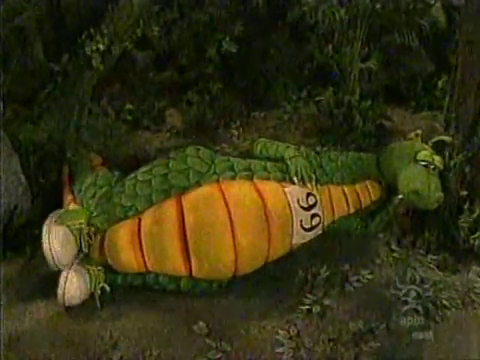
© Breakthrough Entertainment.
Sources: Judy Nyman, Toronto Star, “Play on Energy Conservation a Big Hit,” October 21, 1984, p. E19; Kathy Kastner, Toronto Star, October 2, 1993, “He’s No Dud,” Section C, pg. SW4; Toronto Star, May 13, 1995, “Waterman, Wood created Dudley,” p. C2.
*Kirk Dunn wore the costume in the final three seasons, while Galatis did the voice. That’s Dunn as Dudley in the photo, above.