
Tom Bancroft, Animation Master
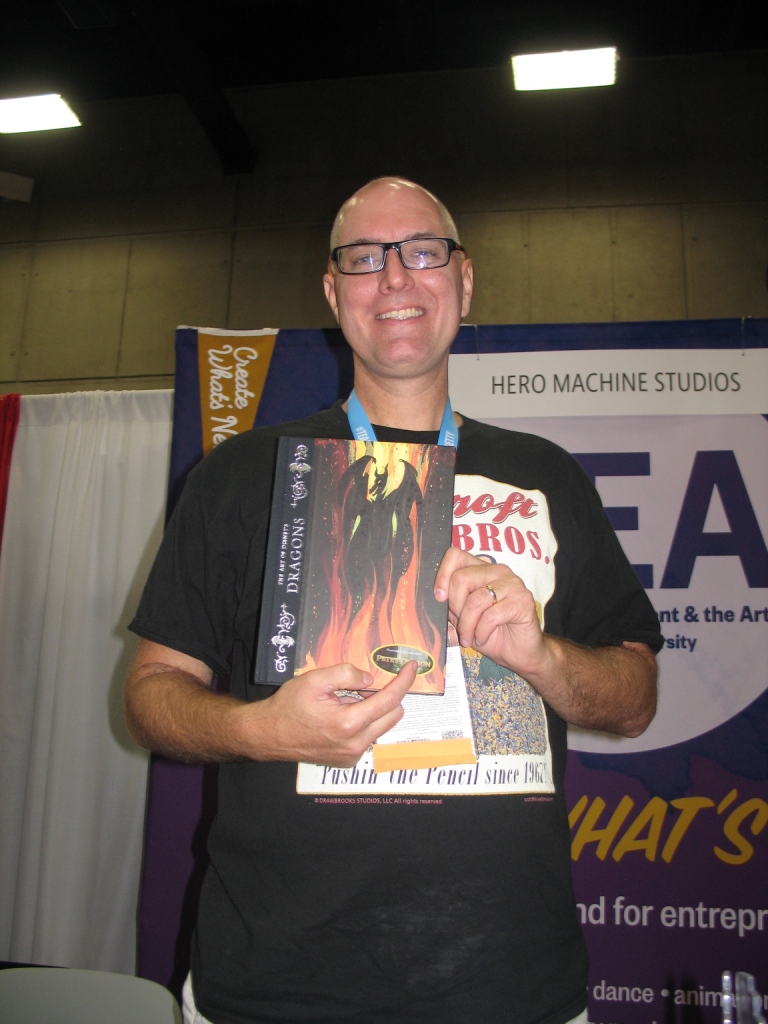
Photo © W.R. Miller.
To help promote the soon-to-be-released live action Pete’s Dragon, Disney has released The Art of Disney’s Dragons, published on June 28. As one would expect, the book showcases designs, drawings, paintings and CG renderings of all of Disney’s dragons from The Reluctant Dragon to both hand-drawn and CG versions of Elliot.
And what better choice to helm such a book than Tom Bancroft, designer and supervising animator for the scene-stealing Mushu from Mulan?
Here’s Tom in action drawing Mushu while his twin brother, director Tony Bancroft, provides behind-the-scenes anecdotes:
Uploaded March 7, 2013
You can see how talented Tom is from his animation reel:
Uploaded December 15, 2011
Years ago I had worked with Tom on Larryboy, a hand-drawn Flash-animated spinoff of Veggie Tales. I was serving as creative director and storyboard artist at Cornerstone Animation in Glendale, CA, while Tom was directing the project from Big Idea Productions.
On Saturday, July 23, I had the pleasure of meeting up with him again at Comic-Con San Diego, where he graciously signed copies of The Art of Disney’s Dragons and posed for pictures.
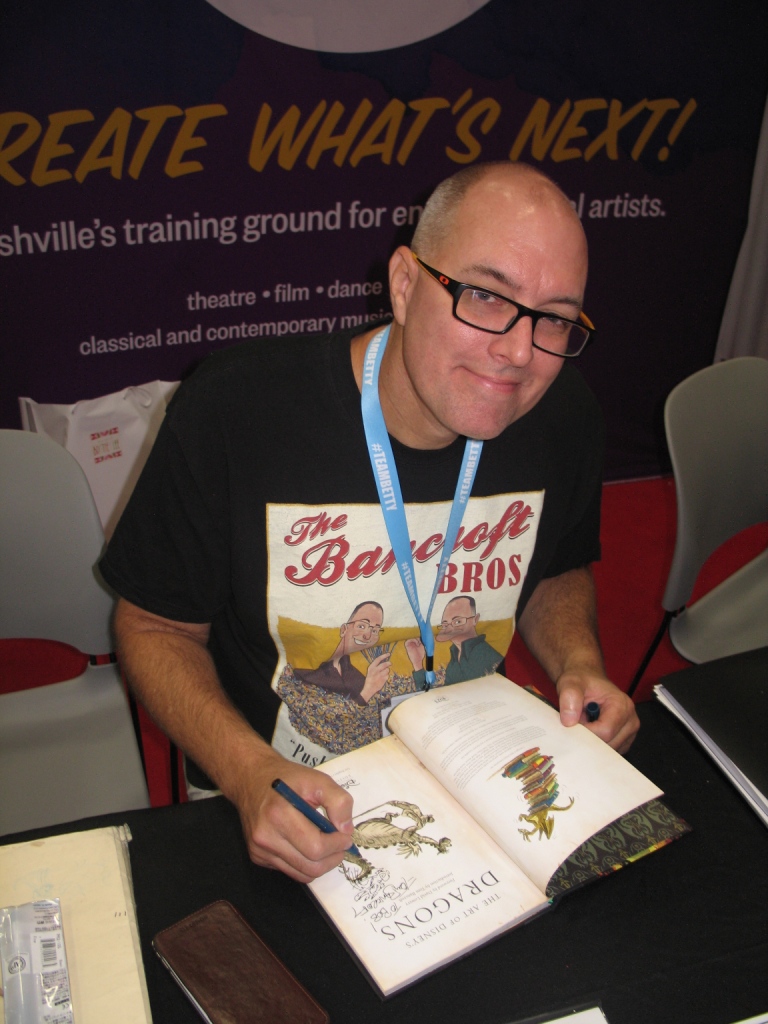
Photo © W.R. Miller.
The Art of Disney’s Dragons has a foreword by Pete’s Dragon director David Lowery, in which he says dragons stand out from other mythical beasts because
1. They have long, serpentine necks. “A short neck will turn a good dragon into something more akin to a goblin.
2. “Sharp claws. You can lose the fangs; you can lose the horns. But a dragon needs something pointy to give it that dragonish edge.
3. “Leathery wings. If the wings have feathers, your dragon will instantly become a griffin or a chimera!”
Oops. So much for the dragons in Dragon Tales.
Alas, the book leaves two questions unanswered:
(1. Why do most Disney dragons have teeny tiny wings?
(2. Why did the live-action Elliot have to be furry?
Promoting Pete’s Dragon
This week it appears Disney is pulling out all the stops in promoting its new live-action Pete’s Dragon, unleashing a torrent of videos on the web and social media. Here are a few videos in chronological order of release:
Disney’s Pete’s Dragon Trailer
https://youtu.be/A7vWCd2Jj-U
Uploaded on June 14, 2016
Elliot in the Air
July 4, 2016
“Is Elliot Your Imaginary Friend?”
Featuring Pete (Oakes Fegley) and Natalie (Oona Laurence)
Uploaded on July 12, 2016
Pete’s Dragon Exclusive First Look | Elliot Takes Pete for a Ride
https://youtu.be/z61DLPmSyH8
Uploaded on July 13, 2016
Pete’s Dragon – David Lowery Interview
https://youtu.be/ifxyhdFsTQ0
Uploaded on July 13, 2016
Pete’s Dragon – Oaks Fegley Interview
https://youtu.be/c8NF02bZ3TQ
Uploaded on July 13, 2016
Pete’s Dragon – Jim Whitaker Interview
https://youtu.be/zsnbhpxRAYI
Uploaded on July 13, 2016
The Vanishing Dragon
July 15, 2016
Behind the scenes of Pete’s Dragon | B-Roll
Uploaded by The Bryce Dallas Howard Network on July 19, 2016
LIVE with the Director & Cast of Pete’s Dragon
July 15, 2016

How to Fly Your Dragon
The Creative Talent Network has uploaded a video in which Cal State San Bernardino biology professor Stuart Sumida and Simon Otto, Head of Character Animation for How to Train Your Dragon, discuss developing real-life references on how dragons could fly.
The presentation can be viewed here.
Mark Muckenfuss wrote about Sumida’s animated career for the Press-Enterprise, “CAL STATE: Professor lives in an animated world,” February 26, 2011, posted online here.
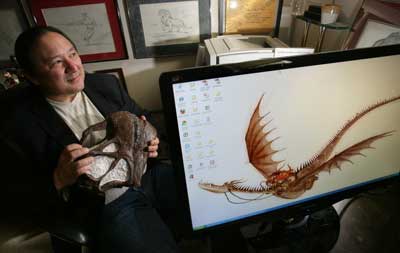
Photo by David Bauman/The Press-Enterprise.
President John Quincy Adams’s 4th of July address, 1837, Part 3: The Separation of People
By John Quincy Adams.
(Continued)
But this is not the reason for which you are here assembled. The question of right and wrong involved in the resolution of North American Independence was of transcendent importance to those who were actors in the scene. A question of life, of fortune, of fame, of eternal welfare. To you, it is a question of nothing more than historical interest. The separation itself was a painful and distressing event; a measure resorted to by your forefathers with extreme reluctance, and justified by them, in their own eyes, only as a dictate of necessity. – They had gloried in the name of Britons: It was a passport of honor throughout the civilized world. They were now to discard it forever, with all its tender and all its generous sympathies, for a name obscure and unknown, the honest fame of which was to be achieved by the gallantry of their own exploits and the wisdom of their own counsels.
But, with the separation of the one people from the other, was indissolubly connected another event. They had been British Colonies, – distinct and separate subordinate portions of one great community. In the struggle of resistance against one common oppressor, by a moral centripetal impulse they had spontaneously coalesced into One People. They declare themselves such in express terms by this paper. – The members of the Congress, who signed their names to the Declaration, style themselves the Representatives, not of the separate Colonies, but of the United States of America in Congress assembled. No one Colony is named in the Declaration, nor is there any thing on its face, indicating from which of the Colonies, any one of the signers was delegated. They proclaim the separation of one people from another. – They affirm the right of the People, to institute, alter, and abolish their Government: – and their final language is, “we do, in the name, and by the authority of the good People of these Colonies, solemnly publish and declare that these United Colonies, are and of right ought to be FREE AND INDEPENDENT STATES.” The Declaration was not, that each of the States was separately Free and Independent, but that such was their united condition. And so essential was their union, both in principle and in fact, to their freedom and independence, that, had one of the Colonies seceded from the rest, and undertaken to declare herself free and independent, she could have maintained neither her independence nor her freedom.
And, by this paper, this One People did notify the world of mankind that they thereby did assume among the powers of the earth the separate and equal station, to which the Laws of Nature and of Nature’s God entitled them.
This was indeed a great and solemn event. The sublimest of the prophets of antiquity with the voice of inspiration had exclaimed, “Who hath heard such a thing? Who hath seen such things? Shall the earth be made to bring forth in one day? Or shall a nation be born at once?” [Isaiah 66:8]. In the two thousand five hundred years, that had elapsed since the days of that prophecy, no such event had occurred. It had never been seen before. In the annals of the human race, then, for the first time, did one People announce themselves as a member of that great community of the powers of the earth, acknowledging the obligations and claiming the rights of the Laws of Nature and of Nature’s God. The earth was made to bring forth in one day! A nation was born at once!
Well, indeed, may such a day be commemorated by such a Nation, from year to year! But whether as a day of festivity and joy, or of humiliation and mourning, – that, fellow-citizens, – that in the various turns of chance below, depends not upon the event itself, but upon its consequences; and after threescore years of existence, not so much upon the responsibilities of those who brought the Nation forth, as upon the moral, political and intellectual character of the present generation, – of yourselves. In the common intercourse of social life, the birth-day of individuals is often held as a yearly festive day by themselves, and their immediate relatives; yet, as early as the age of Solomon, that wisest of men told the people of Jerusalem, that, as a good name was better than precious ointment, so the day of death was better than the day of one’s birth [Ecclesiastes 7:1].
President John Quincy Adams’s 4th of July address, 1837, Part 2: First purpose of the Declaration of Independence
By John Quincy Adams.
(Continued)
For the second object of the Declaration, the assumption among the powers of the earth of the separate and equal station, to which the Laws of Nature and of Nature’s God entitled them, no reason was assigned, – no justification was deemed necessary.
The first and chief purpose of the Declaration of Independence was interesting to those by whom it was issued, to the people, their constituents in whose name it was promulgated, and to the world of mankind to whom it was addressed, only during that period of time, in which the independence of the newly constituted people was contested, by the wager of battle. Six years of War, cruel, unrelenting, merciless War, – War, at once civil and foreign, were waged, testing the firmness and fortitude of the one People, in the inflexible adherence to that separation from the other, which their Representatives in Congress had proclaimed. By the signature of the Preliminary Articles of Peace, on the 30th of November 1782, their warfare was accomplished, and the Spirit of the Lord, with a voice reaching to the latest of future ages, might have exclaimed, like the sublime prophet of Israel, – Comfort ye, comfort ye my people, saith your God [Isaiah 40:1].
But, from that day forth, the separation of the one People from the other was a solitary fact in their common history; a mere incident in the progress of human events, not more deserving of special and annual commemoration by one of the separated parts, than by the other. Still less were the causes of the separation subjects for joyous retrospection by either of the parties. – The causes were acts of misgovernment committed by the King and Parliament of Great Britain. In the exasperation of the moment they were alleged to be acts of personal tyranny and oppression by the King. George the third was held individually responsible for them all. The real and most culpable oppressor, the British Parliament, was not even named in the bill of pains and penalties brought against the monarch. – They were described only as “others” combined with him; and, after a recapitulation of all the grievances with which the Colonies had been afflicted by usurped British Legislation, the dreary catalogue was closed by the sentence of unqualified condemnation, that a prince, whose character was thus marked by every act which might define a tyrant, was unworthy to be the ruler of a free people.
The King, thus denounced by a portion of his subjects, casting off their allegiance to his crown, has long since gone to his reward. His reign was long, and disastrous to his people, and his life presents a melancholy picture of the wretchedness of all human grandeur; but we may now, with the candor of impartial history, acknowledge that he was not a tyrant. His personal character was endowed with many estimable qualities. His intentions were good; his disposition benevolent; his integrity unsullied; his domestic virtues exemplary; his religious impressions strong and conscientious; his private morals pure; his spirit munificent, in the promotion of the arts, literature and sciences; and his most fervent wishes devoted to the welfare of his people. But he was born to be a hereditary king, and to exemplify in his life and history the irremediable vices of that political institution, which substitutes birth for merit, as the only qualification for attaining the supremacy of power. George the third believed that the Parliament of Great Britain had the right to enact laws for the government of the people of the British Colonies in all cases. An immense majority of the people of the British Islands believed the same. That people were exclusively the constituents of the British House of Commons, where the project of taxing the people of the Colonies for a revenue originated; and where the People of the Colonies were not represented. The purpose of the project was to alleviate the burden of taxation bearing upon the people of Britain, by levying a portion of it upon the people of the Colonies. – At the root of all this there was a plausible theory of sovereignty, and unlimited power in Parliament, conflicting with the vital principle of English Freedom, that taxation and representation are inseparable, and that taxation without representation is a violation of the right of property. Here was a conflict between two first principles of government, resulting from a defect in the British Constitution: the principle that sovereign power in human Government is in its nature unlimited: and the principle that property can lawfully be taxed only with the consent of its owner. Now these two principles, carried out into practice, are utterly irreconcilable with each other. The lawyers of Great Britain held them both to be essential principles of the British Constitution. – In their practical application, the King and Parliament and people of Great Britain, appealed for the right to tax the Colonies to the unlimited and illimitable sovereignty of the Parliament. – The Colonists appealed to the natural right of property, and the articles of the Great Charter. The collision in the application of these two principles was the primitive cause of the severance of the North American Colonies, from the British Empire. The grievances alleged in the Declaration of Independence were all secondary causes, amply sufficient to justify before God and man the separation itself; and that resolution, to the support of which the fifty-five Representatives of the One People of the United Colonies pledged their lives, their fortunes, and their sacred honor, after passing through the fiery ordeal of a six years war, was sanctioned by the God of Battles, and by the unqualified acknowledgment of the defeated adversary.
This, my countrymen, was the first and immediate purpose of the Declaration of Independence. It was to justify before the tribunal of public opinion, throughout the world, the solemn act of separation of the one people from the other.
(To be continued)
President John Quincy Adams’s 4th of July address, 1837, Part 1
By John Quincy Adams.
“Say ye not, A Confederacy, to all them to whom this people shall say A Confederacy; neither fear ye their fear, nor be afraid.” Isaiah 8:12.
ORATION.
Why is it, Friends and Fellow Citizens, that you are here assembled? Why is it, that, entering upon the sixty-second year of our national existence, you have honored with an invitation to address you from this place, a fellow citizen of a former age, bearing in the records of his memory, the warm and vivid affections which attached him, at the distance of a full half century, to your town, and to your forefathers, then the cherished associates of his youthful days? Why is it that, next to the birthday of the Savior of the World, your most joyous and most venerated festival returns on this day? – And why is it that, among the swarming myriads of our population, thousands and tens of thousands among us, abstaining, under the dictate of religious principle, from the commemoration of that birth-day of Him, who brought life and immortality to light, yet unite with all their brethren of this community, year after year, in celebrating this, the birth-day of the nation?
Is it not that, in the chain of human events, the birthday of the nation is indissolubly linked with the birthday of the Savior? That it forms a leading event in the progress of the gospel dispensation? Is it not that the Declaration of Independence first organized the social compact on the foundation of the Redeemer’s mission upon earth? That it laid the corner stone of human government upon the first precepts of Christianity, and gave to the world the first irrevocable pledge of the fulfillment of the prophecies, announced directly from Heaven at the birth of the Savior and predicted by the greatest of the Hebrew prophets six hundred years before?
Cast your eyes backwards upon the progress of time, sixty-one years from this day; and in the midst of the horrors and desolations of civil war, you behold an assembly of Planters, Shopkeepers and Lawyers, the Representatives of the People of thirteen English Colonies in North America, sitting in the City of Philadelphia. These fifty-five men, on that day, unanimously adopt and publish to the world, a state paper under the simple title of ‘A DECLARATION.’
The object of this Declaration was two-fold.
First, to proclaim the People of the thirteen United Colonies, one People, and in their name, and by their authority, to dissolve the political bands which had connected them with another People, that is, the People of Great Britain.
Secondly, to assume, in the name of this one People, of the thirteen United Colonies, among the powers of the earth, the separate and equal station, to which the Laws of Nature, and of Nature’s God, entitled them.
With regard to the first of these purposes, the Declaration alleges a decent respect to the opinions of mankind, as requiring that the one people, separating themselves from another, should declare the causes, which impel them to the separation. – The specification of these causes, and the conclusion resulting from them, constitute the whole paper. The Declaration was a manifesto, issued from a decent respect of the opinions of mankind, to justify the People of the North American Union, for their voluntary separation from the People of Great Britain, by alleging the causes which rendered this separation necessary.
The Declaration was, thus far, merely an occasional state paper, issued for a temporary purpose, to justify, in the eyes of the world, a People, in revolt against their acknowledged Sovereign, for renouncing their allegiance to him, and dissolving their political relations with the nation over which he presided.
(To be continued)

Pete’s Puppy
On February 15, 2016, Disney released their teaser trailer for their new version of Pete’s Dragon:
And on April 15, 2016, Entertainment Weekly published an image of what Elliot the Dragon looked like:

This is a dragon?
My curiosity brought me over to Amazon.com to see what books would be published as a tie-in. One such book was
Pete’s Dragon: Elliot Gets Lost Hardcover – June 28, 2016
“A puppy named Elliot and his human family go for a picnic in the woods. But when Elliot wanders off and finds himself lost in the forest, he must decide where he belongs and find his way home.”
So Elliot was originally a puppy and he turned into a dragon to help Pete survive in the forest?
Checking the site today, I find that the book description has changed, with the first sentence eliminated, the second sentence rewritten and more text added:
“Elliot the puppy is lost in the forest, and needs to find a new home. Will it be with a family of sheep, or a questioning owl, or maybe some playful fox cubs? Or will his search lead him somewhere else? From the screen to the page, Elliot Gets Lost will bring the fun and heartwarming story of a lost puppy to readers of all ages. Seen in the 2016 movie Pete’s Dragon as one of Pete’s prized possessions, the picture book was brought to the page by the film’s creative team, and features never-before-seen illustrations. Fans of the movie and picture books alike will love this story of a young puppy’s journey.”
OK. So Elliot is really a dog in dragon flesh. That explains why the dragon is furry.
We’ll find out for sure when the film is released on August 12. Here’s the full trailer uploaded June 14, 2016:
At least this Elliot has wings large enough to support him as he flies!

Meet the Dragon Who Tweets
Not so long ago, in what we colloquially call The Real World, a boy named James tended to ignore advice from his parents, his grandparents and his aunt. He would do things like give away his own presents to others.
“How can we get him to listen?” his aunt Theresa wondered. Then an idea occurred in the form of a wise old dragon named Farloft. Who could ignore a dragon? And so, Theresa Snyder typed out a story starring Farloft and a little boy with the name of … James.

Artwork by BlueKite-Falls of Deviant Art.
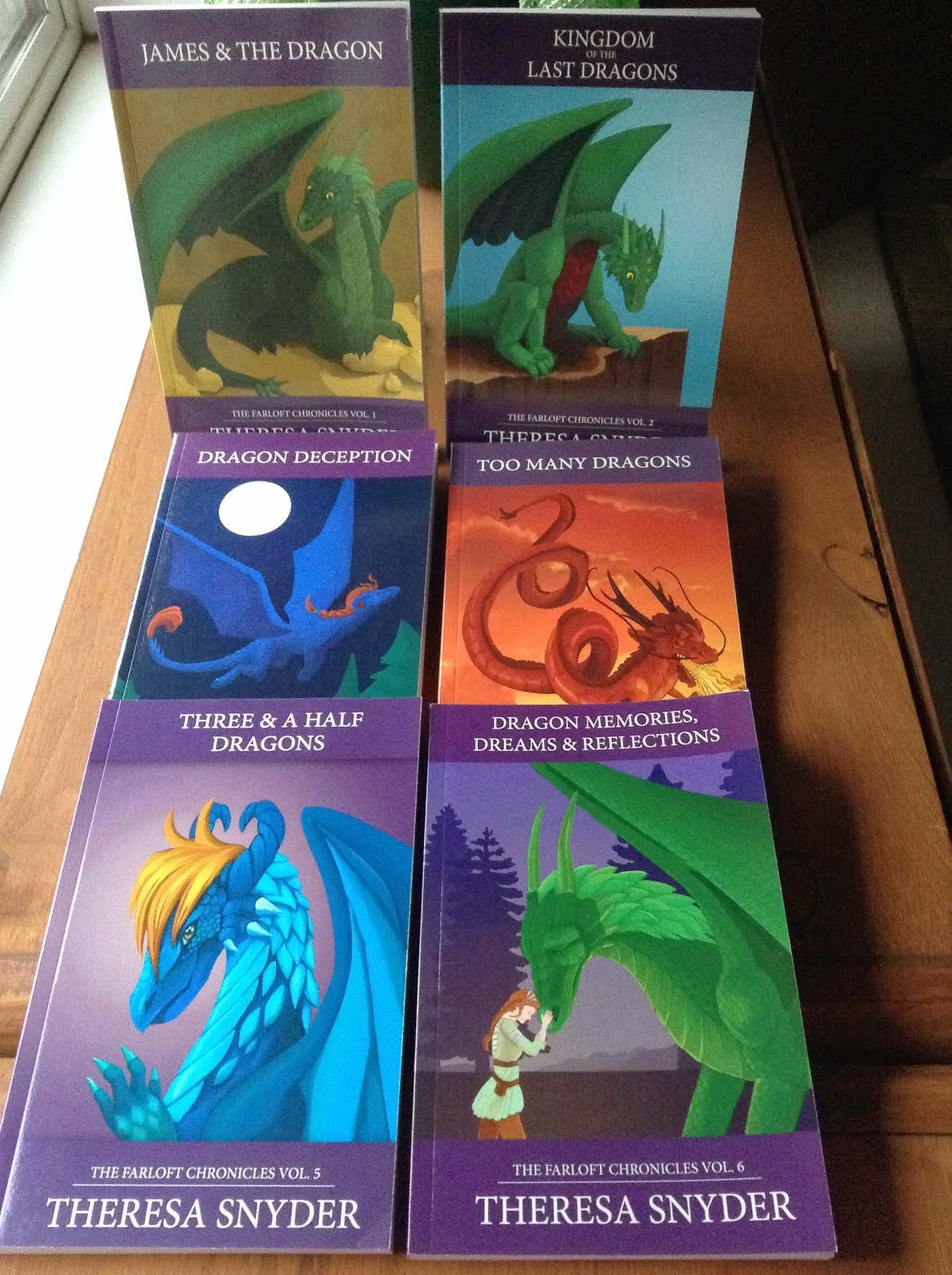
The book, James and the Dragon, gave rise to a series called the Farloft Chronicles, for not only was the dragon charming and wise, he was a veritable fountain of stories.
Theresa Snyder added herself as one of Farloft’s human friends in the second book, Kingdom of the Last Dragons. The series carried on with Dragon Deception, Too Many Dragons, and Three & a Half Dragons.

Artwork by Sarah Hyndshaw.
Back in the Real World, Snyder’s student workers at a school print shop encouraged her to promote her books through social media.
Snyder told blogger Sherry Rentschler, “When they found out I was self-publishing they immediately set me up on Twitter. They said I would be great at it, because I love to chat. They were right.”
Then the Fantasy World intersected with the Real World.
“Farloft found me and he wanted to tweet too,” Snyder said. “He loves being on Twitter the last Friday of every month and because he is old and wise, he can say just about anything he wants to. He is a great mouthpiece. He can push his books or my other books and no one gets tired of listening to him.”
“Folks know him, they look forward to his visits, they expect the same Farloft in the books as they find on Twitter,” she said in an interview with Lisette Brodey. “Because he is in his own kingdom in the books and not in modern times I have to be vigilant and not let his character drift far from how he would react to any question on Twitter. It has made his tweeting very interesting. He is over a thousand years old and very wise. He has been asked to solve problems, mediate disagreements and give sage advice on Twitter.”
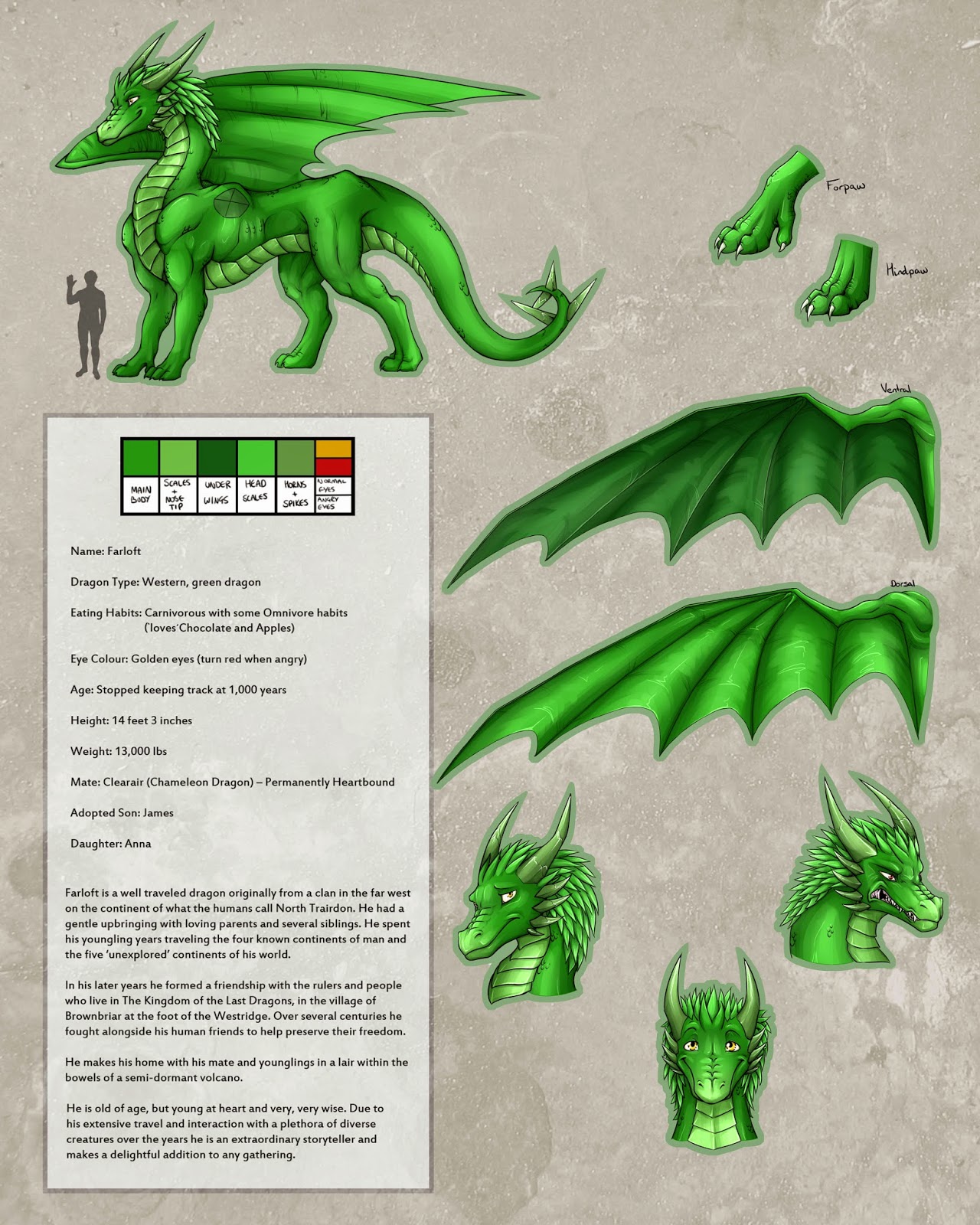
Artwork by BlueKite-Falls of Deviant Art.
During a Twitter chat, one of Farloft’s fans, Charlotte Ashlock, asked the author how she and Farloft met. Lo and behold, the answer came forth in the sixth Farloft adventure, Dragon Memories, Dreams & Reflections. Upon its publication, Ashlock was invited to visit the author at her home, where she received a pleasant surprise—which she reveals in her blog. (Certainly not here. Who am I to spoil her story?)

Author Theresa Snyder knows how to handle hungry dragons. Photo courtesy of Charlotte Ashlock.
The next #FarloftFriday Twitter session is this Friday, June 24. Farloft himself will visit @TheresaSnyder and chat to the extent of Twitter’s 140-character limit. Now you, too, can tweet with a dragon.
For more information about the Farloft Chronicles and Theresa Synder’s other works—plus a review of James and the Dragon by two school kids—watch Denise-Marie’s Fairy Tale Access podcast:
Posted online June 17, 2016.
Click here for a five-star review of James and the Dragon. To listen to the story, click here. To buy the story–which is encouraged because feeding dragons is expensive–click here or here.