
A Proclamation for Thanksgiving, November 27, 1779
General Orders, November 27, 1779. The Writings of George Washington from the Original Manuscript Sources, 1745-1799. John C. Fitzpatrick, Editor.
Head Quarters, Moore’s House, Saturday, November 27, 1779.
Parole Landaft. Countersigns Lexington, Leeds.
The Honorable the Congress has been pleased to pass the following Proclamation.
Whereas it becomes us humbly to approach the throne of Almighty God, with gratitude and praise for the wonders which his goodness has wrought in conducting our fore-fathers to this western world; for his protection to them and to their posterity amid difficulties and dangers; for raising us, their children, from deep distress to be numbered among the nations of the earth; and for arming the hands of just and mighty princes in our deliverance; and especially for that he hath been pleased to grant us the enjoyment of health, and so to order the revolving seasons, that the earth hath produced her increase in abundance, blessing the labors of the husbandmen, and spreading plenty through the land; that he hath prospered our arms and those of our ally; been a shield to our troops in the hour of danger, pointed their swords to victory and led them in triumph over the bulwarks of the foe; that he hath gone with those who went out into the wilderness against the savage tribes; that he hath stayed the hand of the spoiler, and turned back his meditated destruction; that he hath prospered our commerce, and given success to those who sought the enemy on the face of the deep; and above all, that he hath diffused the glorious light of the gospel, whereby, through the merits of our gracious Redeemer, we may become the heirs of his eternal glory: therefore,
RESOLVED, That it be recommended to the several states, to appoint Thursday, the 9th of December next, to be a day of public and solemn thanksgiving to Almighty God for his mercies, and of prayer for the continuance of his favor and protection to these United States; to beseech him that he would be graciously pleased to influence our public councils, and bless them with wisdom from on high, with unanimity, firmness, and success; that he would go forth with our hosts and crown our arms with victory; that he would grant to his church the plentiful effusions of divine grace, and pour out his holy spirit on all ministers of the gospel; that he would bless and prosper the means of education, and spread the light of Christian knowledge through the remotest corners of the earth; that he would smile upon the labours of his people and cause the earth to bring forth her fruits in abundance; that we may with gratitude and gladness enjoy them; that he would take into his holy protection our illustrious ally, give him victory over his enemies, and render him signally great, as the father of his people and the protector of the rights of mankind; that he would graciously be pleased to turn the hearts of our enemies, and to dispense the blessings of peace to contending nations; that he would in mercy look down upon us, pardon our sins and receive us into his favor, and finally, that he would establish the independence of these United States upon the basis of religion and virtue, and support and protect them in the enjoyment of peace, liberty and safety.33
[Note 33: In the General Orders this resolve was condensed by sundry omissions.]
A strict observance to be paid by the Army to this Proclamation and the Chaplains are to prepare and deliver discourses suitable to it.
President John Adams: Origins of the American Revolution, Part Three
Adams, John, 1735-1826. The ‘American Revolution‘, Letter to Hezekiah Niles, first editor of the National Register. Quincy, February 13, 1818. First published in Niles’ Weekly Register, v. 2, n. 14, March 7, 1818.
Continued:
Another gentleman who had great influence in the commencement of the revolution, was Doctor Jonathan Mayhew, a descendant of the ancient governor of Martha’s Vineyard. This divine had raised a great reputation both in Europe and America, by the publication of a volume of seven sermons, in the reign of king George the second, 1749, and by many other writings, particularly a sermon in 1750, on the thirtieth of January, on the subject of passive obedience and non-resistance; in which the saintship and martyrdom of king Charles the first are considered seasoned with wit and satire, superior to any in Swift or Franklin. It was read by every body; celebrated by friends, and abused by enemies. During the reigns of King George the first, and King George the second; the reigns of the Stuarts, the two Jameses, and the two Charleses, were in general disgrace in England. In America they had always been held in abhorrence. The persecutions and cruelties suffered by their ancestors under those reigns, had been transmitted by history and tradition; and Mayhew seemed to be raised up to revive all their animosities against tyranny in church and state, and at the same time to destroy their bigotry, fanaticism and inconsistency. David Hume’s plausible, elegant, fascinating and fallacious apology, in which he varnished over the crimes of the Stuarts, had not then appeared. To draw the character of Mayhew, would be to transcribe a dozen volumes. This transcendant genius, threw all the weight of his great fame into the scale of his country, in 1761, and maintained it therewith zeal and ardor, till his death, in 1766. In 1763 appeared the controversy between him and Mr. Apthorp, Mr. Caner, Dr. Johnson and Archbishop Seeker, on the charter and conduct of the society for propagating the gospel in foreign parts. To form a judgment of this debate, I beg leave to refer to a review of the whole, printed at the time, and written by Samuel Adams; though by some, very absurdly and erroneously, ascribed to Mr. Apthorp. If I am not mistaken, it will be found a model of candor, sagacity, impartiality, and close, correct reasoning.
If any gentleman supposes this controversy to be nothing to the present purpose, he is grossly mistaken. It spread an universal alarm against the authority of parliament. It excited a general and just apprehension that bishops and diocesses and churches, and priests and tythes, were to be imposed on us by parliament. It was known, that neither king, nor ministry, nor archbishops, could appoint bishops in America, without an act of parliament; and if parliament could tax us, they could establish the Church of England, with all its creeds, articles, tests, ceremonies and tythes, and prohibit all other churches, as conventicles and schism shops.
Nor must Mr. Cushing be forgotten.—His good sense and sound judgment, the urbanity of his manners, his universal good character, his numerous friends and connections, and his continual intercourse with all sorts of people, added to his constant attachment to the liberties of his country, gave him a great and salutary influence from the beginning, in 1760.
Let me recommend these hints to the consideration of Mr. Wirt, whose life of Mr. Henry I have read with great delight. I think, that after mature investigation, he will be convinced that Mr. Henry did not “give the first impulse to the ball of independence,” and that Otis, Thatcher, Samuel Adams, Mayhew, Hancock, dishing, and thousands of others, were labouring for several years at the wheel, before the name of Henry was heard beyond the limits of Virginia.
If you print this, I will endeavour to send you something concerning Samuel Adams, who was destined to a longer career, and to act a more conspicuous, and, perhaps, a more important part, than any other man. But his life would require a volume. If you decline printing this letter, I pray you to return it as soon as possible to,
Sir, your humble servant,
JOHN ADAMS.
President John Adams: Origins of the American Revolution, Part Two
Adams, John, 1735-1826. The ‘American Revolution‘, Letter to Hezekiah Niles, first editor of the National Register. Quincy, February 13, 1818. First published in Niles’ Weekly Register, v. 2, n. 14, March 7, 1818.
Continued:
In this research, the glorioroles of individual gentlemen, and of separate states, is of little consequence. The MEANS AND THE MEASURES are the proper objects of investigation. These may be of use to posterity, not only in this nation, but in South America, and all other countries. They may teach mankind that revolutions are no trifles; that they ought never to be undertaken rashly; nor without deliberate consideration and sober reflection; nor without a solid, immutable, eternal foundation of justice and humanity; nor without a people possessed of intelligence, fortitude and integrity sufficient to carry them with steadiness, patience, and perseverance, through all the vicissitudes of fortune, the fiery trials and melancholy disasters they may have to encounter.
The town of Boston early instituted an annual oration on the fourth of July, in commemoration of the principles and feelings which contributed to produce the revolution. Many of those orations I have heard, and all that I could obtain I have read. Much ingenuity and eloquence appears upon every subject, except those principles and feelings. That of my honest and amiable neighbour. Josiah Quincy, appeared to me the most directly to the purpose of the institution. Those principles and feelings ought to be traced back for two hundred years, and sought in the history of the country from the first plantations in America. Nor should the principles and feelings of the English and Scotch towards the colonies, through that whole period ever be forgotten. The perpetual discordance between British principles and feelings, and of those of America, the next year after the suppression of the French power in America, came to a crisis, and produced an explosion.
It was not until after the annihilation of the French dominion in America, that any British ministry had dared to gratify their own wishes, and the desire of the nation, by projecting a formal plan for raising a national revenue from America, by parliamentary taxation. The first great manifestation of this design, was by the order to carry into strict execution those acts of parliament, which were well known by the appellation of the acts of trade, which had lain a dead letter, unexecuted for half a century, and some of them, I believe, for nearly a whole one.
This produced, in 1760 and 1761, AN AWAKENING and a REVIVAL of American principles and feelings, with an enthusiasm which went on increasing, till in 1775 it burst out in open violence, hostility and fury.
The characters, the most conspicuous, the most ardent and influential in this revival, from 1760 to 1766, were—first and foremost, before all and above all, JAMES OTIS ; next to him was OXENBRIDGE THATCHER; next to him, SAMUEL ADAMS; next to him, JOHN HANCOCK; then Dr. Mayhew, then Dr. Cooper and his brother. Of Mr. Hancock’s life, character, generous nature, great and disinterested sacrifices, and important services, if I had forces, I should be glad to write a volume. But this I hope will be done by some younger and abler hand. Mr. Thatcher, because his name and merits are less known, must not be wholly omitted. This gentleman was an eminent barrister at law, in as large practice as any one in Boston.— There was not a citizen of that town more universally beloved for his learning, ingenuity, every domestic and social virtue, and conscientious conduct in every relation of life. His patriotism was as ardent, as his progenitors had been ancient and illustrious in this country. Hutchinson often said, “Thatcher was not born a Plebeian, but he was determined to die one.” In May 1763, I believe he was chosen by the town of Boston one of their representatives in the legislature, a colleague with Mr. Otis, who had been a member from May 1761, and he continued to be re-elected annually till his death in 1765, when Mr. Samuel Adams was elected to fill his place, in the absence of Mr. Otis, then attending the congress at New-York.— Thatcher had long been jealous of the unbounded ambition of Mr. Hutchinson, but when he found him not content with the office of lieutenant-governor, the command of the castle and its emoluments, of judge of probate for the county of Suffolk, a seat in his majesty’s council in the legislature; his brother-in-law secretary of slate by the king’s commission; a brother of that secretary of state, a judge of the supreme court and a member of council, now in 1760 and 1761, soliciting and accepting the office of chief justice of the superior court of judicature, he concluded, as Mr. Otis did, and as every other enlightened friend of his country did, that he sought that office with the determined purpose of determining all causes in favour of the ministry at St. James and their servile parliament.
His indignation against him henceforward, to 1765, when he died, knew no bounds but truth. I speak from personal knowledge. For, from 1758, to 1765,1 attended every superior and inferior court in Boston, and recollect not one in which he did not invite me home to spend evenings with him, when he made me converse with him as well as I could, on all subjects of religion, morals, law, politics, history, philosophy, belles-lettres, theology, mythology, cosmogony, metaphysics,—Lock, Clark, Leibnits, Bolinbroke, Berkley,—the pre-established harmony of the universe, the nature of matter and of spirit, and the eternal establishment of coincidences between their operations, fate, foreknowledge absolute—and we reasoned on such unfathomable subjects as high as Milton’s gentry in pandemonium; and we understood them as well as they did, and no better. To such mighty mysteries he added the news of the day, and the tittle tattle of the town. But his favourite subject was politics, and the impending threatening system of parliamentary taxation, and universal government over the colonies. On this subject he was so anxious and agitated, that I have no doubt it occasioned his premature death.— From the time when he argued the question of writs of assistance, to his death, he considered the king, ministry, parliament and nation of Great Britain, as determined to new-model the colonies from the foundation; to annul all their charters; to constitute them all royal governments; to raise a revenue in America by parliamentary taxation; to apply that revenue to pay the salaries of governors, judges, and all other crown officers; and, after all this, to raise as large a revenue as they pleased, to be applied to national purposes at the exchequer in England; and further to establish bishops, and the whole system of the Church of England, tythes and all, throughout all British America. This system, he said, if it was suffered to prevail, would extinguish the flame of liberty all over the world; that America would be employed as an engine to batter down all the miserable remains of liberty in Great Britain and Ireland, where only any semblance of it was left in the world. To this system he considered Hutchinson, the Olivers, and all their connections—dependants—adherents—shoelickers—and entirely devoted. He asserted that they were all engaged with all the crown officers in America, and the understrappers of the ministry in England, in a deep and treasonable conspiracy to betray the liberties of their country, for their own private, personal and family aggrandisement. His Philippicks against the unprincipled ambition and avarice of all of them, ut especially of Hutchinson, were unbridled; not only in private, confidential conversations, but in all companies and on all occasions. He gave Hutchinson the sobriquet of “Summa Potestatis,” and rarely mentioned him but by the name of ” Summa.” His liberties of speech were no secrets to his enemies. I have sometimes wortdered that they did not throw him over the bar, as they did soon afterwards Major Hawley. For they hated him worse than they did James Otis, or Samuel Adams, and they feared him more,—because they had no revenge for a father’s disappointment of a seat on the superior bench to impute to him, as they did to Otis; and Thatcher’s character through life had been so modest, decent, unassuming —his morals so pure, and his religion so venerated, that they dared not attack him. In his office were educated to the bar, two eminent characters, the late Judge Lowell, and Josiah Quincy, aptly called the Boston Cicero. Mr. Thatcher’s frame was slender, his constitution delicate: whether his physicians overstrained his vessels with mercury, when he had the small pox by inoculation at the castle, or whether he was overplyed by public anxieties and exertions, the small pox left him in a decline from which he never recovered. Not long before his death, he sent for me to commit to my care some of his business at the bar. I asked him whether he had seen the Virginia resolves? “Oh yes—they are men! they are noble spirits! It kills me to think of the lethargy and stupidity that prevails here. I long to be out. I will go out. I will go out. I will go into court, and make a speech which shall be read after my death, as my dying testimony against this infernal tyranny which they are bringing upon us.” Seeing the violent agitation into which it threw him, I changed the subject as soon as possible, and retired. He had been confined for some time. Had he been abroad among the people, he would not have complained so pathetically of the “lethargy and stupidity that prevailed,” for town and country were all alive; and in August became active enough, and some of the people proceeded to unwarrantable excesses, which were more lamented by the patriots than by their enemies. Mr. Thatcher soon died, deeply lamented by all the friends of their country.
President John Adams: Origins of the American Revolution, Part One
Adams, John, 1735-1826. The ‘American Revolution‘, Letter to Hezekiah Niles, first editor of the National Register. Quincy, February 13, 1818. First published in Niles’ Weekly Register, v. 2, n. 14, March 7, 1818.
Quincy, February 13, 1818.
MR. NILES,
The American Revolution was not a common event. Its effects and consequences have already been awful over a great part of the globe. And when and where are they to cease?
But what do we mean by the American Revolution? Do we mean the American War? The revolution was effected, before the war commenced. The revolution was in the minds and hearts of the people. A change in their religious sentiments, of their duties and obligations. While the king, and all in authority under him, were believed to govern in justice and mercy, according to the laws and constitution derived to them from the God of nature, and transmitted to them by their ancestors—they thought themselves bound to pray for the king, and queen, and all the royal family, and all in authority, under them, as ministers ordained of God for their good. But when they saw those powers renouncing all the principles of authority, and bent upon the destruction of all the securities of their lives, liberties and properties, they thought it their duty to pray for the Continental Congress, and all the thirteen state congresses, &c. There might be, and there were others, who thought less about religion and conscience, but had certain habitual sentiments of allegiance and loyalty derived from their education; but believing allegiance and protection to be reciprocal, when protection was withdrawn, they thought allegiance was dissolved.
Another alteration was common to all. The people of America had been educated in an habitual affection for England, as their mother country; and while they thought her a kind and tender parent, (erroneously enough, however, for she never was such a mother,) no affection could be more sincere. But when they found her a cruel beldam, willing like lady Macbeth, to “dash their brains out,” it is no wonder if their filial affections ceased, and were changed into indignation and horror.
This radical change in the principles, opinions, sentiments and affections of the people, was the real American Revolution.
By what means, this great and important alteration in the religious, moral, political and social character of the people of thirteen colonies, all distinct, unconnected and independent of each other, was begun, pursued and accomplished, it is surely interesting to humanity to investigate, and perpetuate to posterity.
To this end it is greatly to be desired that young gentlemen of letters, in all the states, especially in the thirteen original states, would undertake the laborious, but certainly interesting and amusing task, of searching and collecting all the records, pamphlets, newspapers, and even hand-bills, which in any way contributed to change the temper and views of the people, and compose them into an independent nation.
The colonies had grown up under constitutions of government so different, there was so great a variety of religions, they were composed of so many different nations, their customs, manners and habits had so little resemblance, and their intercourse had been so rare, and their knowledge of each other so imperfect, that to unite them in the same principles in theory, and the same system of action, was certainly a very difficult enterprise. The complete accomplishment of it, in so short a time and by such simple means, was, perhaps, a singular example in the history of mankind.—Thirteen clocks were made to strike together; a perfection of mechanism which no artist had ever before effected.

Nick Kellington: Spinning with SkekMal
On Twitter, creature performer Nick Kellington disclosed several behind-the-scenes details about his character, SkekMal the Hunter, from The Dark Crystal: Age of Resistance.

October 30, 2019:
“4 BTS facts courtesy of Mechanical Designer, Ady Parish: My SkekMal head was built in about 3 weeks. It only used 9 servos to power the face Was programmed on a Taranis x9d radio control unit. And the tongue was CGI.”

October 12, 2019:
“I remember being totally blown away by how beautiful this spinning shot was. DOP Erik Alexander Wilson always did an amazing job but this was particularly breathtaking. After we’d filmed it, it was being played on repeat on the studio monitors. I just watched it again and again, spinning round and round. It was hypnotic. I also recall thinking that it was perhaps one of the most beautiful shots I’d filmed on any series. Technically it had been a tricky shot to set up with a massive spinning camera on a huge extending crane. It wasn’t particularly difficult for me (other than the weight, heat and pain of the costume which is expected) but poor Neil Sterenberg (Rian’s Puppeteer) was hanging off a platform, puppeteering upside down all day.
“When I grabbed Rian by the neck I could feel Neil’s arm inside moving around. Gelflings are around the same size as a child and it felt so disturbing as he struggled, gross!
“I think this was also my first scene with #TheChamberlain (who is puppeteered by Warrick Brownlow-Pike @WarrickBP). It has often been mentioned how fabulously Warrick puppeteers #skekSil but he also performs the voice on set as we’re filming and I have to say, Warrick TOTALLY nails that too.
“For some reason I don’t get my ‘Additional Puppeteer’ credit on Episode 5 ‘She Knows All the Secrets’ which is odd when our scene opens up the episode. Still I can’t grumble, I’m just happy I got to play skekMal (with Kevin Clash puppeteering his face)
“Cheers for reading and take it easy.”

See here for Nick describing his scenes of the Hunter attacking a couple of unfortunate Gelflings.
See here for SkekMal bowling with Gelflings!

Nick Kellington: Bowling with Gelflings
On September 9, 2019, creature performer Nick Kellington tweeted on Twitter about performing in the climactic battle in The Dark Crystal: Age of Resistance. With his kind permission, I share his story here:

“In sequence shown in this gif, director Louis Leterrier asked me to sprint as fast as I could across the full length of the set in the #SkekMal suit. The air was thick with dust clouds from the SFX explosions going off as I passed them so was tricky to see where I was going plus I had to avoid the large weapons and spiked armour wielded by the other #Skeksis and deep trenches in the set that the puppeteers stood in. All this in a very heavy creature costume with limited visibility. It was exhausting but I absolutely LOVED IT!
“One thing I took inspiration from, was that for take after take, Louis was running the gauntlet with me, carrying and operating the steady cam just ahead of me, travelling BACKWARDS! (Shades of Fred Astaire and Ginger Rogers) Louis is just brilliant and I loved working with him!
“As a slight addition to this BTS story, at the end of this GIF when SkekMal bowls Rian up the steps, due to me wearing the costume hands which don’t allow me to bend my fingers and grip properly, when I threw him, I could get Rian to hit the steps but not with as much violence and momentum as Louis Leterrier wanted. So up stepped Lead Puppeteer @victor_yerrid to help out. What you see in the finished sequence is Rian leaving my/SkekMal’s hand and then it cuts to Rian crashing into the steps which Victor performed. It looks great!
“Incidentally the same thing happened with SkekMal and Hup in the Circle of the Suns sequence. I start the throw and Victor finishes it. I did get Hup onto the balcony on 2 out of 3 takes but Victor’s landing obviously must have been prettier! Poor Hup and poor Rian!”
See here for Nick’s account of his first day of operating the Hunter.
See here for his account of SkekMal’s fight with the two Gelflings.

Nick Kellington: The Hunter’s First Day
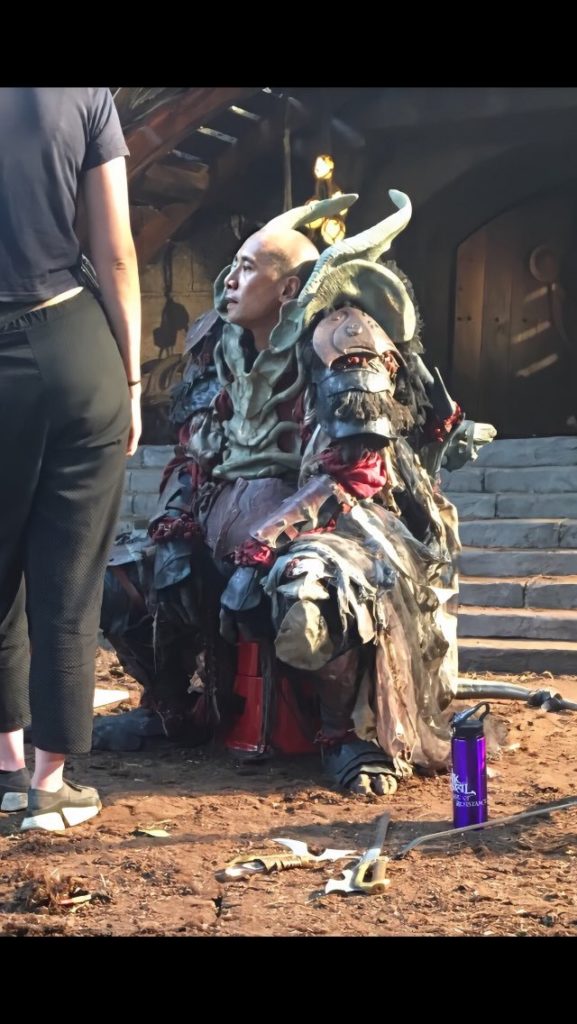
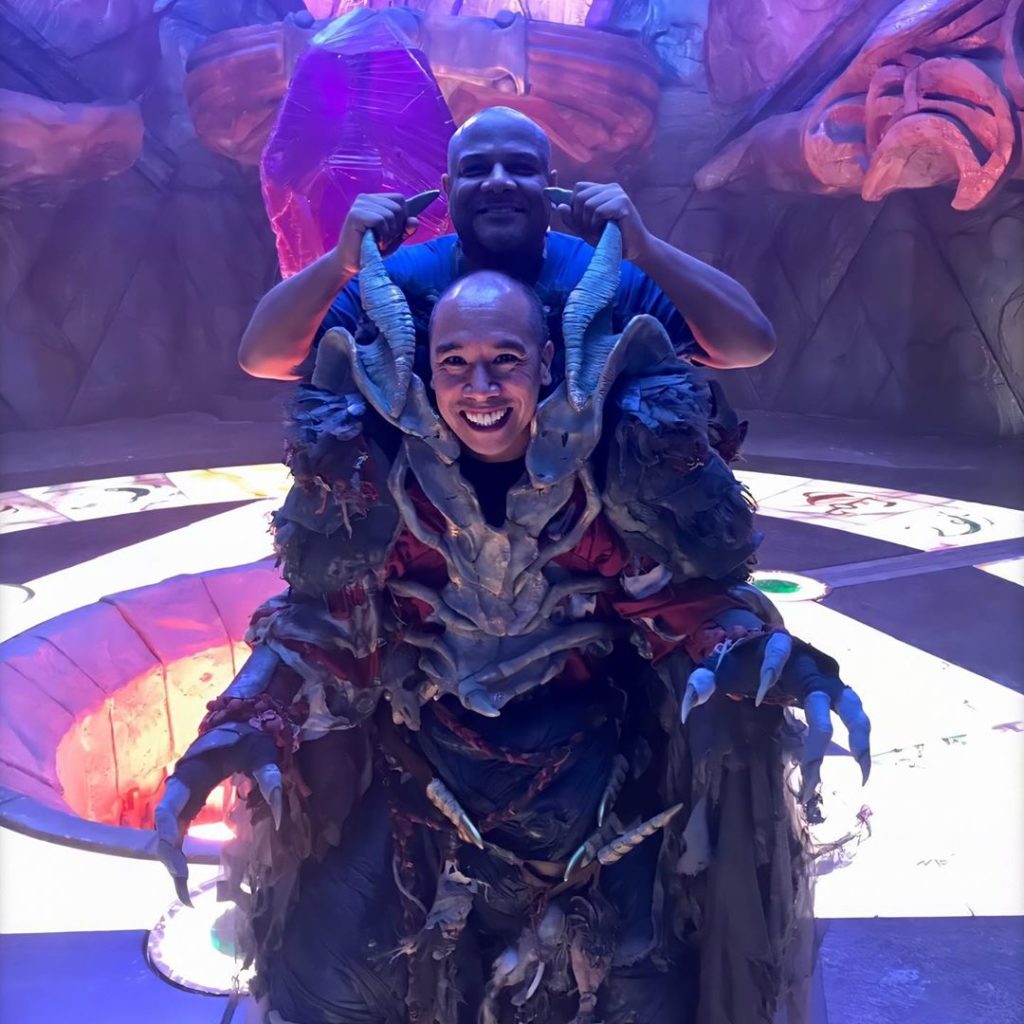
Nick Kellington, creature performer on The Dark Crystal: The Age of Resistance, plied his skills as the body operator for the Skeksis Hunter, SkekMal. On September 18 on Twitter, he shared what it was like on his first day on the set of the Castle Throne room:
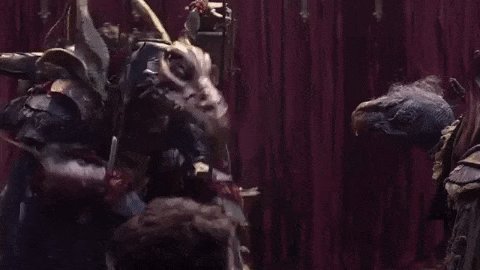
“The day we filmed the scenes featured in this [image] was my first day on set. It was slightly nerve wracking as the production had already been filming for a few months and so was a well oiled machine with a tight cast and crew by this point. Everyone knew their roles and how the studio floor ran and I was the newbie on set. Also, that day was the first time I’d be working with Kevin Clash who, as Lead Puppeteer on SkekMal, has creative responsibility over the character’s performance. With Kevin having worked so extensively with Hensons and especially having been Elmo, he’s one of the most famous and experienced puppeteers in the world, so I was expecting him to hold me to high standards, which he did.
“It was a big set up in The Throne Room with all the Skeksis, a few of the puppeteers I knew already, but I’d had no rehearsal for this scene at all. At home, I’d read the scripts of the episodes SkekMal was in but was only given the sides of the scenes we were filming that morning so I learned them over breakfast. On set, Director Louis Leterrier briefly introduced me to the crew as the guy who was going to be in the Hunter and then it was straight to business.
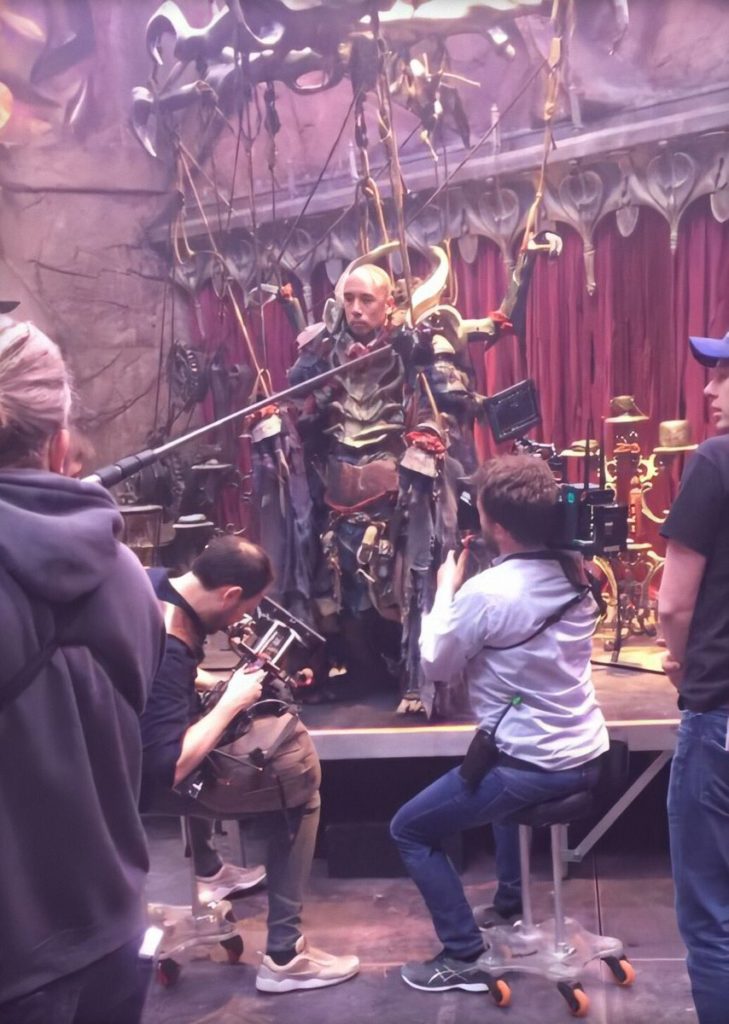
“I think I saw some faces, I now recognise, as producers and writers who were also on the studio floor. This was SkekMal’s first day on set and understandably, I’m sure they wanted to check the character out too. I was invited in for a rehearsal with Louis and the core puppeteers to block out the day’s scenes before showing them to the rest of the crew, no puppets for them (they use their hands instead) and no animatronic head for me. Thankfully in the first set up I was strung up like a marionette with all the Skeksis around me. I didn’t have any action other than to hang there so that bought me a few minutes breathing space to get into it.
“Next I blocked out a scene with SkekMal and SkekTek, played by Olly Taylor. I’m not sure why but I was delivering my lines. Kevin would usually perform them but for that very first block through I think he was organising the new RC rig that he uses to puppeteer SkekMal’s face. So with full gusto, I broke free from the ropes that bound me and angrily growled “WHERE’S RYAN?!!!”
“‘Err, it’s Rian’, said Louis in his cool French accent (Ree-an). Like I said, I’d read the script but I hadn’t double checked how to pronounce all the character names with anyone. DOH! With my first two words I’d just screwed up in front of the Director, all the core puppeteers and maybe some producers too . . . so there wasn’t MUCH more to be nervous about.
“Also Louis was really cool with me so after that, I just got on with the job and enjoyed myself from there on in. (And believe me I did!) I LOVED performing in the SkekMal suit and I hope it shows in the finished series. Thanks for reading, I hope you’ve found it interesting.
“Cheers!”
See here for Nick describing his scenes of the Hunter attacking a couple of unfortunate Gelflings.
See here for SkekMal bowling with Gelflings!

Nick Kellington: Behind the Scenes with The Hunter!

Beware all you Gelflings and malcontents of Thra! Defy the Skeksis, Lords of the Crystal, and they will sic SkekMal on you. Yes, SkekMal, the terrifying Hunter in The Dark Crystal: Age of Resistance. You wouldn’t want to end up as one of his trophies.
Though, despite all SkekMal’s tracking skills and blade-slashing and nasty temperament, he couldn’t do it without the able assistance of creature performers Nick Kellington, operating the body; Kevin Clash working the head and mouth and Ralph Ineson speaking on the Hunter’s behalf.
On September 10, 2019 on Twitter, Nick talked about his experience filming the Hunter’s fight with a couple Gelflings, Rian and his father Ordon. With his kind permission, I’m sharing his words below.
“The fight sequence that this [image] is taken was sooo much fun to film and really exhausting to perform. I had such a blast. We filmed it in one day, in the morning vs Neil Sterenberg and in the afternoon vs both Neil and Dave Chapman. I’d had one day’s rehearsal to learn the sequence with Stunt coordinator @ianpkay [Ian Kay] (who also choreographed the awesome fight) and then we were on. It wasn’t much rehearsal but Ian was a great teacher and was very patient with me. Both Neil and Dave did incredibly well that day (especially Neil because he was on for the whole day with me) as once the set had been lit we pretty much went at it the whole day taking minimal breaks. Also those guys were holding tiny swords via their puppets vs myself wielding these massive #Hunter swords!
“Director Louis Leterrier kept asking for more power and aggression from me and poor Neil was on the receiving end hanging onto puppet and sword for dear life AND giving and incredible performance as Rian at the same time Ian kept an eye on the fight at the monitor and between takes would run in and give me tips on how to sell the fight more and make it work for the camera, all this whilst Louis was giving us notes on the what he wanted from the scene and Kevin Clash was giving me notes about what he wanted from SkekMal as a character.
“It was a lot of info to take in on top of remembering/performing the fight (in a heavy creature suit with limited vision) but that’s just part of my job. SkekMal’s claws don’t allow me to close my grip fully so I sneakily tucked the handles of my blades into the straps on my costume so they wouldn’t fly out of my hand as I was swinging them around (which they never did).
“At one point, when I spin around to attack with my tail, Rian ducked but Neil didn’t and the tailwhipped Neil in the face! (He was wearing goggles). It must have stung mightily but he took it like a champ and after a few seconds we went again for another take.
“In the afternoon we were joined by Dave, and Matt Lyons and Callum Dixon who puppeteered SkekMal’s extra arms and we continued filming the second half of the fight. It was like a dance between the five of us (again, hats off to Ian for the choreography) and everyone worked so hard to get it right. We were all glad of the short breaks when my head was swapped between the lighter stunt head and the fully animatronic head so that Kevin could perform the dialogue and SkekMal’s facial reactions in the sequence.
“I was pushed both physically and mentally that day (and sore at the end of it) but it is an on set experience that I will never forget. Not wanting to get into spoilers but there is a “fall” in the sequence that Ian performed the Hunter for, as it was classed as a stunt, which was filmed a few days later. He did a great job and I thank him for both that and all his help filming the fight.”
Nick Kellington can be followed on Twitter, as @NickKellington.

A Dragon Flight Cycle from Den Beauvais
Designed and animated by Den Beauvais using Animation Master 2001. Enjoy:

For a frame-at-a-time analysis:

Happy Halloween from Sam Witwer
Sam Witwer has a Halloween greeting for you!
From Twitter:
Trick or Treaters. I stand ready to confront you. #HappyHalloween2019